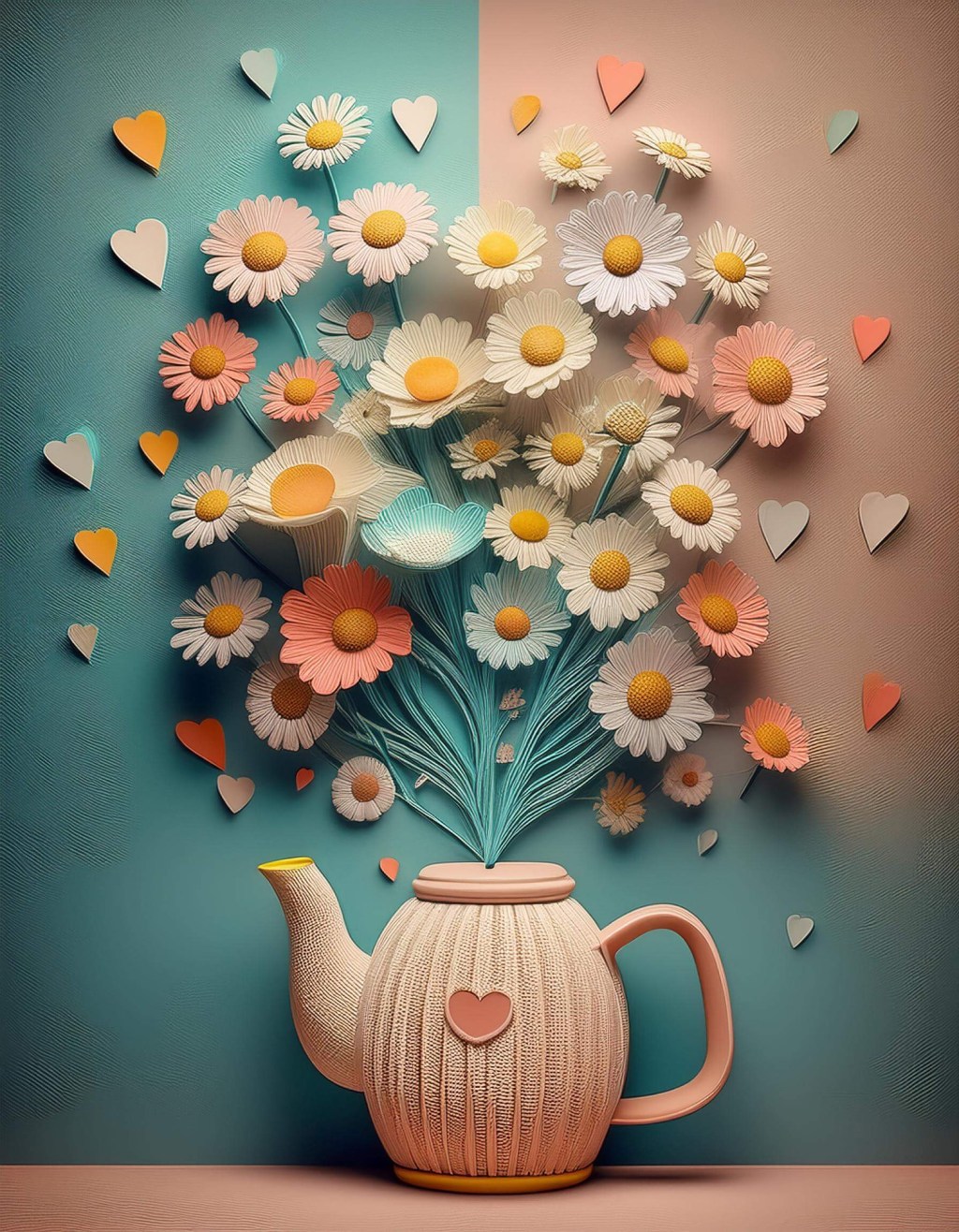
Daisy blossoms are reliable weather indicators. Expect it to rain if they remain closed in the morning. Hence, their English name derived from “day’s eye” or “the eye of day”, “day see” maybe. Their botanical name is Bellis perennis which means as much as “beautiful/ cute throughout the year”. Daisies are naturally growing in Central Europe where depending on your area, you can harvest the blossoms on a sunny day in nature between April and September.
Many mystical stories and tales are surrounding the daisy. A herb that is popular in herbalism to treat colds, coughs and skin infections in infants and toddlers. Also in adults, daisy blossoms are famously applied as a natural remedy to treat a variety of ailments.
Norse mythology sees the daisy connected to Freya, the goddess of love, beauty, fertility, sex, war, gold, and a seiðr (someone practicing the magic of seeing and influencing the future), associating the plant with fertility, new beginnings and indicative of its future relation with a to date popular game of divination. In Celtic lore, daisies are seen as symbols of simplicity and innocence. According to a Christian tale, the daisy was created by the tears Maria cried on her escape to Egypt. In another lore, those tears belonged to the beautiful Helena of Troy.
In folk medicine, daisy is used as a tea, tincture or fresh plant to treat respiratory diseases, arthritis and rheumatism. Other famous applications of the daisy are various skin issues which is what we are going to pursue a bit farther. The herb contains a diverse set of minerals and essential oils, amongst them is silicic acid, an ingredient that is important for beautiful and strong fingernails, hair, bones, tissue and skin. For external use, daisies are processed into ointments, cremes and tinctures. Daisy flower extract is used in skin brightening, after-sun, and anti-aging products.
Daisies make a popular ingredient to spring or summer detox treatments, act cleansing, expectorative, astringent, anti-inflammatory; diuretic and wound-healing. The herbal tea is commonly applied internally to cleanse and stabilise our skin, externally in the form of face masks to soften and refresh or balms to remedy dry skin, adding a protective layer. The blossoms are also used as an after sun lotion or cosmetics to treat unclean skin and infected skin such as eczema or acne. Its contained combination of essential oils, flavonoids and saponins bring a diverse set of benefits to the skin.
A Daisy Tea Recipe and an easily self-made Face Mask
These qualities make daisy blossoms a more than just beautifully looking, special tea ingredient and brilliant to craft your own effective, natural face masks.

A Skin Refreshing Daisy Flower Tea
This tea recipe could simply be integrated as a morning or evening ritual to support a balanced skin.
⏱️ Prep Time 2 min
⏳ Waiting Time 10 – 15 min
🫖 Suggested Pot Size 250 ml (~ 0.5 pint)
🍵 Cups 1 – 2
Ingredients
- 2 teaspoons of Daisy flowers
- 1 teaspoon of Goldenrod
- 1 teaspoon of Chamomile blossoms
Directions
- Add your herbs in a sieve or empty tea bag and place it in a 250 ml cup or pot
- Poor boiling water over your herbs
- Cover the tea pot, for example with a small plate, and leave your tea to steep for 10 to 15 minutes
- Enjoy 🍵
Goldenrod is traditionally used as a medicinal plant to treat problems relating to the urinary tract and kidneys, rheumatic diseases or gout. The species name is Solidago virgaurea. The herb is astringent, diuretic, antiseptic, antioxidant, spasmolytic, anti-inflammatory and antibacterial, famous also as an internal and external remedy to eczema and other skin irregularities. Chamomile, also called Matricaria recutita, is anti-inflammatory, antispasmodic, antibacterial, antiviral, antifungal, soothing, ulcer-protective and promotes wound healing. Although medicinally popularly applied externally onto skin issues or infections, its plentiful benefits have made Chamomile blossoms a traditionally also internally for the skin recommended herbal remedy. I find the odour of a fresh, good quality Chamomile blossoms tea simply mesmerising. Especially if you are used to tea bags, the aromatic difference in scent and flavour is breathtaking. A completely different cup of tea, really!

A Skin Refreshing Daisy Flower Face Mask
This is a level up of a homemade skincare product compared to simply soaking your cotton pad in the tea above and delightfully refreshing your skin with it like a face water. Nevertheless, this recipe is so easy that it will possibly change your mind about self-made skincare products. I did a before/ after comparison by applying the face mask to half of my face only and I am totally convinced of its wonderfully softening and refreshing feeling to the skin ever since.
⏱️ Prep Time 3 min
⏳ Waiting Time 30 min
🥣Bowl Size 2 x 100 – 150 ml (~ 0.3 pint)
🧴 Face Mask 1 – 2 Applications
Ingredients
- 1 tablespoon of dried daisy blossoms
- roughly 150 ml (~ 0.3 pint) of water
- 2 tablespoons of oat bran (alternative you could also use a bio oatmeal)
- approx. 1 tablespoon of honey
Directions
- Pour around 100- 150 ml of boiling water over one tablespoon of dried daisy blossoms.
- Cover the brew to protect the essential oils and leave to infuse for 30 minutes.
- Pass the infusion through a sieve.
- Get a second bowl or cup to prepare the face mask.
- Mix 3 tablespoons of the lukewarm infusion (!Don’t use the entire 150 ml as you’ll realise that you end up with way too much liquid in the next step!) with 2 tablespoons of oat bran (Use oatmeal if you have no other purpose for the bran or simply struggle to find any. It solely will result in a bit coarser texture of the mask.)
- Add around 1 tablespoon of honey. (It took me a bit of trial and error as the original recipe stated 1 teaspoon of honey which doesn’t feel sticky enough to me. Also make sure that the brew is not cold as it will make it more difficult to mix the ingredients.)
- Apply to the face.
- Leave the face mask on for about 15 minutes.
- Rinse off with lukewarm water.
- The skin becomes wonderfully soft.
A perfect light skincare during spring and summertime!
Oat bran, like oatmeal, adds various benefits to the face mask due to its antioxidant, anti-aging, moisturising and skin-tightening properties. It also reduces skin inflammation and is said to potentially boost collagen production for a firmer skin. Oatmeal will enhance the peeling effect of the mask a bit as the texture is coarser. Honey is rather well known for its manifold health benefits! Applied externally, it helps balance the bacteria on your skin, has antioxidant, anti-aging, anti-inflammatory and exfoliating properties and is therefore said to help reduce acne, cleanse our pores or even to potentially reduce scaring.
I hope you enjoyed this experience of a quickly homemade natural and nurturing skincare!
Feeling all crafty now? Check out Corina’s elderberry cordial recipe for a magically regenerative and antioxidant addition to your tea or food. Find out more in her latest post: The 3 Super Powers of the Black Elderberry and a Delicious Recipe.
– with love –
🪴🧴Lina
sown & uprooted
https://for-a-better-living.com
Please note: As with all things in life, some things will have ripple effects and the amounts make the difference. So please don’t overdose herbal teas either. Especially if you are on medication, suffer a medical condition, are prone to allergic reactions and during pregnancy it’s recommended to seek medical advisory before starting any self medication.
Where to buy Daisy, Goldenrod and Chamomile Tea?
Linked below for you are purchase options of the herbs that I used in the tea recipe and face mask. Living in the countryside, I order many things online, hence I only recommend products I truly value. Nevertheless, as an Amazon Associate I earn from qualified purchases, so buying through these links, you will indirectly contribute to our blog (at no extra costs for you).
Daisy flower tea felt more difficult to find online than the other herbs . I linked here the one I bought in the end: Naturix24 Daisy Tea – Daisy Whole – 100g Bag
Biojoy Organic Goldenrod Tea (250 g), Goldenrod Tea, Dried and Cut (Solidago virgaurea)
A good quality Chamomile blossoms tea makes such a big difference in smell and flavour. Biotiva Infusão de flores de camomila orgânica 100 g – preenchida e verificada na Alemanha (DE-ÖKO-005)
Resources
English alternative: Medical Herbalism: The Science and Practice of Herbal Medicine
 sown & uprooted
Leave a comment