
3 powerful herbal remedies when you have run out of flame…remedies to one of society’s most discussed health issues on the rise: Burnout.
You possibly hardly recognise yourself: Easily triggered aggressive responses, snappy negative comments towards colleagues or loved ones, an ever increasing cynicism towards life, a loss of purpose, feelings of energy depletion and exhaustion, decreased motivation and a certain apathy at the workplace, abandonment of social life, friends, family and partners, a loss of desire for intimacy, a lack of time dedicated to self care and individual health; our human responses are just as manifold as is the spectrum of origins for a phenomenon that has become a critical health condition, an issue slowly spreading its influence throughout society.
“When work and professional environments are not well organized and managed, they can have adverse consequences for workers that, far from dignifying them, exhaust them and consume their psychological resources. Burnout has become one of the most important psychosocial occupational hazards in today’s society, generating significant costs for both individuals and organizations.”
The clinical study from 2022 was mainly reviewing Covid-19’s effects on mental health and burnout, however, it is a very interesting read as it not only explores the origins of the phenomenon in healthcare workers, but also reflects on the need to broaden our current view of the origins and symptoms. “36% Of Managers Report Alarming Levels Of Stress And Burnout In 2024” titled the Forbes magazine one of their recent articles, illuminating facts and results of studies on workplace well-being and stress. Reasons for burnout are complex and by now different types of burnout have been recognised, summarized by the WHO as occupational burnout.
In Reclaiming My Time: A Journey of Self-Rediscovery and Letting Go my friend and co-author Corina has written about her own problems with being overwhelmed and tells you about the moment in time when she herself slowly slipped into burnout. Challenges not tied to one certain lifestyle or profession. You might enjoy reading her post for some ideas that go beyond the 3 powerful herbal remedies that we are going to take a look at in this article.
Adapting with Adaptogens
Adaptogens are herbs that take their name quite literal and help us adapt to stressful life situations. Adaptogens help us overcome energy depletion and fatigue, enhance our mental clarity and ability to focus, are antioxidant, anti-inflammatory and antidepressant, thus are applied to different symptoms of chronic stress, including burnout. There is still some uncertainty about the ingredients responsible for the special adaptogenic effects of the herbs. It is known that the adaptogenic effect comes mainly from the substances that plants produce for their own stress adaptation and which, interestingly, also stimulate and balance our human stress response by providing us with their natural defenses and helping us to recover.
There is a physical component to chronic stress and burnout. Neurotransmitters and our hormonal balance are affected. Within this complex system, also the production of serotonin, acetylcholine, dopamine and cortisol are going off grid. Life feels particularly overwhelming in constant ups and downs, when we feel frantic, cannot focus, lack the energy to tackle the tasks at hand, doubt the success of our efforts or stress anxiously over every little detail! Let’s add the odd bit of vitamin deficiency, difficulties to fetch a good nights sleep: we turn into a mildly depressed warrior, fighting for survival day after day, week after week, just like our ancestors had to fight life threatening circumstances in the wild.
Especially in combination with a healthy diet, adaptogens help us find a way back into civilization, rebalancing an often outdated, rather intense physical stress response. The influence on the hypothalamic-pituitary-adrenal axis (HPA) is decisive for the adaptogenic effect in particular. There is an important difference between adaptogens and stimulants such as coffee, mate or guarana, which are utilized for a disproportional increase in available energy and reduced recovery time. Adaptogens enable an increase in performance with lowered energy consumption of the body, almost like an economization of our performance.
3 Powerful Herbs to Heal from Chronic Stress & Burnout
Take a few deep breaths and prepare to roll up your sleeves. Let us clear the space within you that you need to thoroughly think through, plan and tackle everything that is required for a healthy, necessary life change to support a full recovery from chronic stress and burnout.
Rhodiola Rosea, also called Golden Root or Rose Root, has been known as a medicinal herb in Russia and Scandinavia since ancient times. The Vikings valued its strengthening effect, especially before battle. The golden root made people wide awake and allowed the brain to perform miraculous feats, which was important before a battle where stamina and reaction speed were important. The Vikings also attributed magical fertility powers to the root and used golden root to protect themselves from colds.
Golden Root normalizes the release of stress hormones, while at the same time promoting our energy metabolism. Nowadays, golden root is often combined with Magnesium and Vitamin Bs. Rhodiola Rosea gives us the resilience we need to overcome the constant ups and downs, while also having a long-term positive effect on our natural cortisol levels and other neurotransmitters. Due to its antioxidant and anti-inflammatory properties, the root has a protective effect on diseases such as heart attacks, depression, Alzheimer’s and dementia. It protects various tissue structures such as the central nervous system, our liver and muscles. Golden root supports our cognitive function and is an aid if you struggle to remember facts or can’t focus quite so easily. A herb therefore often utilized in stressful times of study, when a high mental performance is required.
The second powerful herb is Ginseng, Panax Ginseng, or commonly called Man-Root. The plant was discovered over 5000 years ago and has been praised as a strength-generating miracle root ever since. Ginseng is a plant that is considered to be particularly life-giving and life-prolonging due to the human-like shape of the root. The botanical name alone reflects the high esteem in which the plant is held to this day. Pan akomai, Greek I heal everything, ginseng, Chinese human root. I heal everything with the human root.
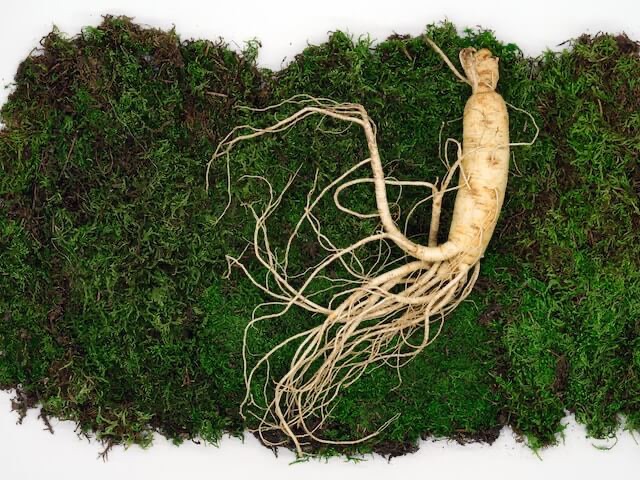
The superpower of Panax Ginseng is the enhancement of our general well-being and the strengthening of the immune system throughout the body due to the plant’s antioxidant qualities. It is applied to revitalize our mental capacity and ability to maintain focus, to reactivate our mental and physical resilience in particularly stressful or mentally demanding situations and to revive our vitality. It is also used to improve the physical endurance of athletes. One reason why athletes can benefit from taking the herb is that the root improves the oxygen supply to the lungs. Ginseng can also improve our libido and like this it helps unravel the magically positive effect of regained intimacy with your partner, which is physically and mentally so easily pushed onto the back burner when life means overwhelm.
Last but not least, the third powerful plant to be rightfully mentioned is Eleutherococcus Senticosus, Siberian Ginseng or so called Taiga Root, sometimes named Devil’s bush or Touch-Me-Not due the thorns covering the stems and branches. Taiga root is also known as an adaptogen and was often used as a substitute for ginseng in the past. It is traditionally found mainly in North-East Asia, particularly Eastern Siberia. Taiga root has anabolic, adaptogenic and performance-enhancing properties. It also has pronounced immunostimulating and modulating effects. Extracts of taiga root show antiviral activities. There are various influences on the metabolism, lowering blood pressure, cholesterol and sugar levels. It has antioxidant and hepatoprotective properties. As for Golden Root and Panax Ginseng, also the Taiga Root has been subject to a variety of clinical studies, leaving it not only traditionally but also scientifically accepted as “a prophylactic and restorative tonic for enhancement of mental and physical capacities in cases of weakness, exhaustion and tiredness, and during convalescence” (read more).
Sure, the real task is to change or at least optimize our lives and the use of our own resources, to relax emotionally and to find new techniques for coping with stress, but it feels easier and prevents us from slipping into depression when we feel that personal power is flowing through our veins and we have enough energy to implement these changes!
The 3 powerful herbal healing roots can be found in various forms these days, however it is often much easier to consume them as a high quality herbal supplement. Nevertheless, please don’t take these remedies for more than two to three months without medical supervision. Incorporating mindfulness techniques into your daily routine and trying out magically relaxing, wellness-oriented tea rituals can help you achieve greater inner peace and resilience!
Would you like to find out more about chronic stress and its symptoms? In my recent articles: Conquering Stress & Anxiety: A Tea Recipe to Calm Down and Sleep Well and Happier: A Tea Recipe to Alleviate Depressive Moods, you will find tea recipes to help you heal from anxiety or mild depression.
– with love –
Lina
sown & uprooted
https://for-a-better-living.com
Please note: As with all things in life, some things will have ripple effects and the amounts make the difference. So please don’t overdose herbal teas or supplements either. Especially if you are on medication, suffer a medical condition, are prone to allergic reactions and during pregnancy it’s recommended to seek medical advisory before starting any self medication.
 sown & uprooted
Leave a comment