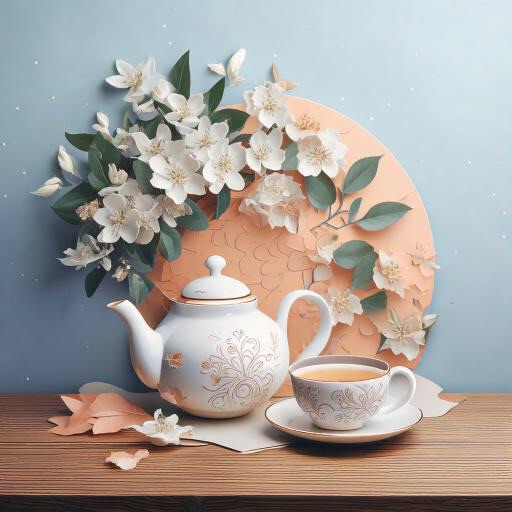
I love to deeply inhale the scent emanating from my jar of orange blossoms when I unscrew the lid, the bitter fruity smell circulating around my nostrils. This brief moment of mindful presence makes the procedure itself, from opening the jar to the first sips of warm comforting tea, a joyful ritual of self-care.
The combination of a refreshing leafy white or green tea with the fruity orange blossoms creates an orange flavoured mildly bitterish tea that can be served as a rather special alternative to black tea or coffee. Beyond that the ingredients hold several benefits to our well-being and a long tradition as beverages, in daily routines, ceremonies and healing.
Plus: this tea makes a lovely regenerative skin care, so you can use any leftovers of the brew under your shower or simply refresh your skin with a soaked cotton pad.
White Orange Blossom Tea [Recipe]
You know those stunningly beautiful big Chinese tea cups that come with a porcelain lid? They are a perfect household item for tea lovers! However, you can use any cup or small pot of your liking.
For a standard sized big cup of tea, I mix:
- 1 teaspoon of White Tea (you could also use Green Tea)
- 1 to 1.5 teaspoons of Orange Blossoms
Cover the herbal infusion while steeping and leave it soak for 5 – 7 mins. Add honey to your liking. Enjoy!
Some benefits of these ingredients
White Tea and Green Tea are both made from the Camellia Sinensis plant. Since early on in human history, the plant has been cultivated in India, Sri Lanka, China and Japan. Especially green tea was used in ceremonies across Japan and China, later imported to Europe and spread across the globe where most of all its black tea variation won incredible popularity. In particular the British culture can hardly be thought of without a cup of tea, can’t it? Nevertheless, according to scientific research, green tea and white tea bring us by far more health benefits than their black counterpart. The less fermented varieties, in particular white tea as the least processed, are high in antioxidants and help strengthen the mucous membrane of our intestine. In Ayurvedic healing traditions the tea is also used as a tonic for our nerves. There have been several scientific studies promoting a diverse set of health benefits, potentially even a protective function for our teeth or anti-aging qualities.
In her post “Natural Medicine – My ode to broccoli and broccoli sprouts” my co-author friend Corina has composed a smoothie recipe using green tea in a very different way. It’s super tasty and definitely adds greatly to your five a day.
Orange Blossom or Citrus Aurantium has been used by traditional healers as nervinum to maintain a healthy nerve function, to strengthen our nervous system or to regain vitality after longer periods of sickness. In the form of a tea the blossoms can help us release some nervousness and stress. It is also recommended as support to our digestive system, for example consumed after the meal in cases of indigestion. Orange blossoms have mild spasmolytic qualities which is one reason why the tea helps us ease tensions. The fruit, peel and blossoms of oranges have been used in a variety of healing traditions, for example by Chinese healers to regulate our life force energy (Qi) and as vital support for our immune system. The tea is often found in flower combinations reviving the love we hold for ourselves.
Keep blossoming!
– with love –
Lina
sown & uprooted
https://for-a-better-living.com
Please note: As with all things in life, some things will have ripple effects and the amounts make the difference. So please don’t overdose herbal teas either. Especially if you are on medication, suffer a medical condition, are prone to allergic reactions and during pregnancy it’s recommended to seek medical advisory before starting any self medication.
 sown & uprooted
Leave a comment